
A Stanford champion for the ages.
Peter Bing, ’55, a member of the Board of Trustees for 31 years, died earlier this month. He was 91. Bing’s support was felt across campus over six decades of volunteer service and philanthropy. He and his wife, Helen, were the forces behind numerous campus efforts, including Bing Concert Hall, Bing Nursery School, and the Bing Overseas Studies program, which now enables about half of all undergraduates to spend a quarter studying abroad. After the 1989 Loma Prieta earthquake, the couple stepped forward to support the restoration of the original part of Green Library; the Bing Wing opened in 1999. In 1994, Bing received the Degree of Uncommon Citizen, for “rare and extraordinary service to Stanford.” Gerhard Casper, Stanford’s president at the time, said that Bing’s devotion to the university “was grounded in the conviction that education enlarges our capacity for understanding and enriches our humanity. He was, in the truest sense, an uncommon citizen of the university.”
Give your brain a break.
It’s not just you—it really is harder to concentrate these days. Our watches, smartphones, and computers dole out dopamine with every notification ping, and once the brain becomes accustomed to those quick hits, it’s more difficult to perform effortful, sustained thinking. So, what’s a person to do? Stanford Medicine experts have recommendations, including giving your brain a break. Whether that’s quality sleep at night or the recommended 10 minutes of downtime per hour of work, it’s crucial to give your brain the chance to replenish its ability to concentrate. And if you’re interested in something more, self-hypnosis might help you reach a flow state. Using techniques of meditation to visualize a problem or task—as well as its solution—can give you more control over your attention. “Focus is a skill, an advantage that we humans have that allows us to determine where and how we deploy our attention,” said David Spiegel, a professor of psychiatry and behavioral sciences. “It’s an opportunity to prove to ourselves how much control we have over our bodies and our minds.”
Addressing labor trafficking in Brazil.
Deforestation in Brazil often relies on the exploitation of workers in conditions analogous to slavery. Illegal work sites are intentionally hidden from sight in remote areas of the Amazon rainforest. Now, researchers in the Stanford Human Trafficking Data Lab have devised a way to find them and rescue people. Each site includes an almost geometric lineup of kilns, which burn trees for charcoal and produce thick smoke. “From space, these sites are clear as day,” said Kimberly Babiarz, the lab’s research director. Using geospatial data and remote detection algorithms, the researchers built a model that found nearly 200 previously unknown charcoal production sites. Since they shared their map with law enforcement, prosecutors have been able to inspect 130 sites, and there has been a surge in both the number of site raids and workers rescued. The lab is now expanding its work in Brazil’s charcoal sector. “We found a way to build a solution big enough to meet the scale of the problem in a corner of the world that really needs it,” said Babiarz.
Commence celebration!
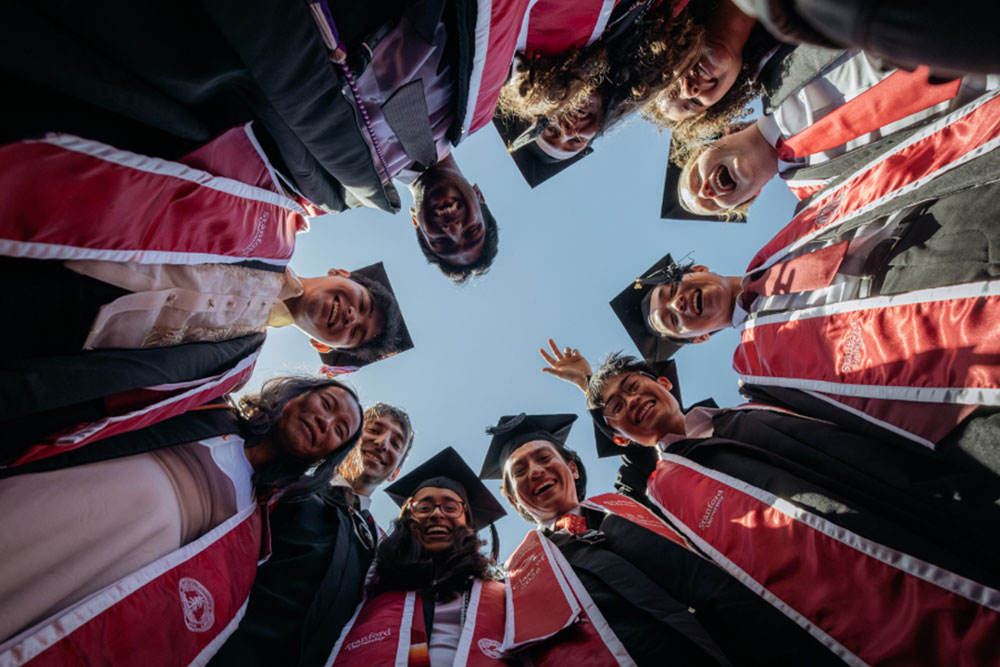 Photo: Andrew Brodhead/University Communications
On June 14, the university awarded 2,006 bachelor’s degrees, 2,870 master’s degrees, and 1,090 doctoral degrees during Stanford’s 135th Commencement. The graduates entered the field in the usual spectrum of Cardinal style—some in unembellished regalia, others in pterodactyl costumes. In his keynote address, Google and Alphabet CEO Sundar Pichai, MS ’95, encouraged graduates to choose optimism, gravitate toward challenges, and do things that excite them. “You have thousands of moments ahead of you,” he added. “The important thing isn’t to get them all right; it’s to find a way to keep moving forward.”
Class action.
When it comes to answering questions from law students, AI may do it better than professors—according to a professor himself. In a new study led by Stanford law professor Julian Nyarko, 16 law professors around the country generated 40 questions about contract law that they might expect to get from students, say, after class. All 16 professors answered the questions, as did AI models, which gave the experts a run for their rebuttals. In blind comparisons, the professors preferred the AI responses over those written by their human peers, with AI winning 75 percent of head-to-head matchups. What’s more, professors flagged AI responses as pedagogically harmful only 3.5 percent of the time, compared to 12 percent for peer-written answers. “We were frankly surprised by the magnitude of the results,” said Nyarko. “These weren’t just simple questions with obvious answers.” The findings suggest that, if deployed responsibly, AI tutors could offer high-quality support to complement classroom instruction.
But wait, there’s more…
Some plant cell membranes “anchor” to the cell wall, making them more resistant to stress during water deficits. The more anchors, the better. Now, researchers have identified the protein systems responsible for these anchors. The new insight could help in the development of drought-resistant crops.
Just over a year after becoming head coach of the San Antonio Spurs, Mitch Johnson, ’09, took the team to the NBA finals.
A type of immune cell discovered in flatworms can “explode like a bomb” to kill surrounding cells—a mechanism that may be beneficial in targeted treatments of bacterial infections or tumors in humans.
Pulitzer Prize–winning physician-author Siddhartha Mukherjee, ’93, writes in the New York Times about his attempt to teach AI how to create novel cancer drugs, but also about the questions of connection and belonging that arise along the way.
People who take weight-loss medications like Ozempic or Wegovy often lose muscle along with fat. An oral drug in clinical trials for age-related muscle loss shows promise in mice on GLP-1 medications.
What are you reading this summer? Stanford magazine asked 10 students for their recommendations.
Note: The Loop sometimes links to articles outside of Stanford that may require a subscription to view.