
Triple header.
When the World Cup kicks off on Thursday in Mexico, it will make soccer and Stanford history. For the first time ever, the 96-year-old event will be co-hosted by three countries—Canada, the United States, and Mexico. Overseeing the sport in all three nations are Stanford alums: Kevin Blue, ’05, CEO and secretary general of Canada Soccer; classmate JT Batson, ’05, who holds the same position in the United States; and Ivar Sisniega, ’79, executive president of the Mexican Football Federation. “There’s a huge hunger for watching fútbol around the world,” Sisniega told Stanford magazine. He, Blue, and Batson are gearing up for 104 games (up from 64 in the past seven World Cups), including six at Levi’s Stadium in Santa Clara. While the players will be in the spotlight, it’s the fans that make the games so fun to prepare for, said Batson. “To see their smiles and how much they’re looking forward to it, that to me is—you get to be a little kid again.”
Shocking results.
Sea squirts may be strange, sack-like creatures that can fit in the palm of your hand, but among all invertebrates on the planet, they’re actually our closest cousins, sharing 70 percent of humans’ genetic material. The uncanny resemblance makes them ideal research subjects, and a new study reveals how the little squirts may help us reverse aging—underwater and, potentially, in humans. When Stanford researchers attached a pacemaker to a colony of sea squirts, they were shocked. Just three rounds of five-minute pulses dramatically improved health and longevity, recharging stem cells by shutting down gene activity and then ramping it back up, similar to a human body showing signs of stress followed by strengthening and repair after a run. The results suggest that an electrical boost may be able to help organisms like corals become more resilient, and perhaps someday improve stem cell survival and fertility in humans. Just not without further testing, said senior research scientist Jos Domen: “We certainly don’t want to encourage people to toss their hair dryer in the bathtub.”
Stick it to the mom.
For physicians who need to monitor high-risk pregnancies, currently available tools provide only snapshots, not real-time information, and are often dependent on the availability of a nurse or ultrasound technician. To obtain continuous information about blood flow, researchers have developed a wearable ultrasound patch, called UPatch, that adheres to the abdomen like a sticker and connects to a computer that interprets ultrasound data. “There’s nothing similar to our device on the market or in the scientific literature,” said senior author Sheng Xu, a professor of anesthesiology, perioperative, and pain medicine. The UPatch can image all three of the major blood vessels in the umbilical cord, measure blood flow through a major artery in the fetus, and measure fetal anatomical structures. While testing the device on 62 pregnant women, researchers found it to be statistically equivalent to a standard Doppler ultrasound machine. Even for inpatients with cardiotocography monitors strapped to their abdomens to measure fetal heart rate and uterine contractions, “obtaining accurate readings three times a day can be labor intensive,” said Jane Chueh, a clinical professor of obstetrics and gynecology. “I think this device will be able to give us that information much more easily.”
Golf glory.
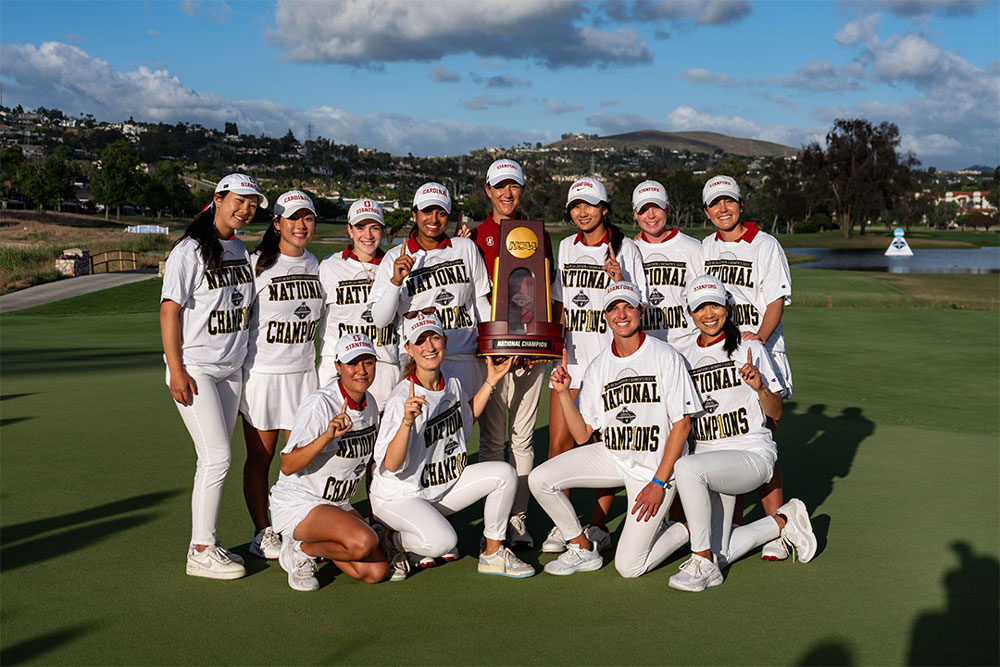 Photo: Stanford Athletics/Ben Nichols
On May 27, the Stanford women’s golf team became NCAA champs for the third time in five years, driving, chipping, and putting their way to a 3–0 victory over USC. “They understand that the person on either side of them is one of the best players in the world and that only helps elevate them,” said Anne Walker, the director of women’s golf. “There’s no competition or jealousy. They just want to elevate one another on the biggest stage.” Their title is the second of the 2025–26 campaign (the first being men’s gymnastics), which extends the Cardinal’s streak to 50 straight years with at least one NCAA team title.
But wait, there’s more…
After a two-year study of academic dishonesty and a pilot project, Stanford will allow—but not require—exam proctoring in all classes this coming fall, for the first time since the Honor Code was adopted in 1921.
Stanford Medicine researchers have discovered two biological subtypes of migraines based on blood flow in the brain. The finding could lead to new treatment guidelines based on migraine severity rather than frequency.
Networking may feel forced and cringy, but it’s linked to long-term professional success and satisfaction. To network in a more meaningful, natural way, former tech exec Nita Singh Kaushal, ’03, advises building relationships by reaching out, showing up, and following up.
Take a peek inside a big space with a tiny mission: The 29,600-square-foot Deep Lab is Stanford’s new hub for nanoscale research and engineering.
UC Davis professor of law Sarah Polcz, JSM ’12, JSD ’19, and George Washington University associate professor of law Jeremy Bearer-Friend, JD ’14, have a proposal to ensure that the public isn’t financially devastated by AI’s effects on jobs and more: Tax systemically important AI firms with stock, not cash, to create a sovereign wealth fund.
If a store wants to sell rotisserie chickens, it should put the freshest ones in front, according to researchers at the Graduate School of Business. Contrary to popular practice, pushing older items to the back leads to more overall sales and the sale of better-quality items on average.
Stanford Medicine research shows that in patients with schizophrenia, neutrophils—the body’s most common white blood cells—are initiating increased production of C4A, a protein linked to the disease. This suggests some underlying mechanisms take place outside the brain.
Jacqueline Novogratz, MBA ’91, and Paul R. Williams, JD ’90, are this year's recipients of the Stanford Award for the Advancement of the Common Good. Novogratz, the founder and CEO of the global impact investment organization Acumen, has worked to uplift under-resourced communities and develop solutions for global poverty. Williams, co-founder of the Public International Law and Policy Group, has shaped peace processes in some of the world's most intractable conflicts.
Note: The Loop sometimes links to articles outside of Stanford that may require a subscription to view.