Features
Editor’s Choice
Features
Dozens of Japanese American Stanford students were corralled in camps during World War II. Even as their lives were put on pause, some stayed connected to the Farm.
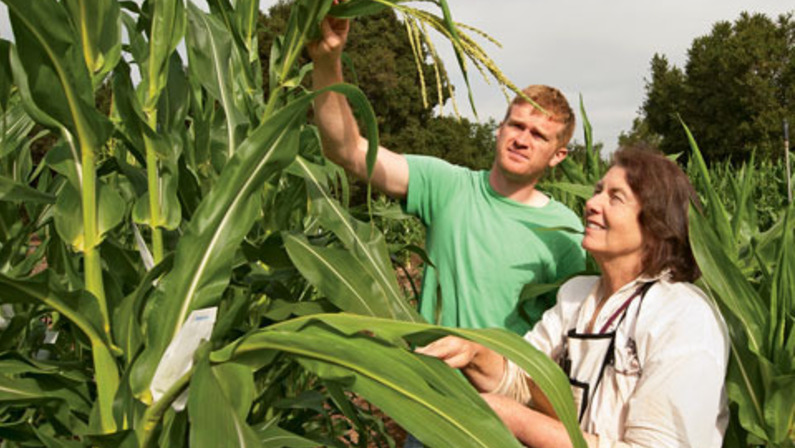
Nature Nurtured
Geneticist Virginia Walbot, '67, helped pioneer a path for women scientists decades ago. Today, her research is unlocking important mysteries about how plants develop.
by Krisin Sainani

Seeing at the Speed of Sound
Deaf since birth, master's student Rachel Kolb, '12 describes her lifelong struggle to communicate with hearing people by reading their lips.
by Rachel Kolb
Can I Get Some Privacy?
The pervasive collection, analysis and sale of personal data mined from Internet sites raises troubling privacy questions. Scholars at Stanford are helping lead efforts for more transparency and stricter controls.
by Brian Eule

The Visible Hand
Whether it's matching medical interns with hospitals, students with public schools, or kidney donors with patients, economist Alvin Roth doesn't just analyze markets, he makes them run better.
by Marina Krakovsky

The Last of a Class
What happens to the memories of a class when all of its members are gone? Ephraim Engleman is 101 years old and keeping the flame alive for the Class of 1933. He has some tales to tell.
by Kevin Cool

Finely Tuned
After decades of making do with subpar facilities, faculty and students are singing the praises of the Bing Concert Hall, whose beauty and acoustical fidelity will put Stanford's performing arts programs in a whole new arena.
by Cynthia Haven

In a Last Wild Place
Lions are being lost at an alarming rate across Africa. Biologist and wildlife photographer Susan McConnell traveled to a reserve in Mozambique to see why they're in trouble, and what's being done to help.
by Susan McConnell

Who Needs the Humanities at ‘Start-Up U’?
Galvanized by perceptions that Stanford is primarily a training ground for tech entrepreneurs, humanities faculty are working to show the value, relevance and strength of their programs.
by Mike Antonucci
How the Truth Gets Twisted
Fuzzy memories aren't the only problem with relying on eyewitness testimony in the courtroom, says psychologist Elizabeth Loftus, MA '67, PhD '70. Her research has shown that what we think we remember can be completely contrived.
by Ann Marsh and Greta Lorge

Time to Cash Out?
As electronic methods for exchanging money proliferate, we are getting closer to a day when our pockets are empty. What are the benefits of a cashless economy, and what are the obstacles?
by Kara Platoni