
A Cardinal election wave.
Xavier Becerra, ’80, JD ’84, was elected governor of California last week (where he’ll cross paths with new California insurance commissioner Jane Kim, ’99). Becerra was formerly U.S. Secretary of Health and Human Services in the Biden administration, attorney general of California, and a U.S. representative. He’ll be the state’s first Latino governor and the third Stanford alum to hold the office—following Goodwin Knight, Class of 1919, and Gray Davis, ’64. And we can’t forget founding family member Leland Stanford himself, elected 165 years ago.
As for members of Congress elected in 2026, we’ll take a dozen! Senators Cory Booker, ’91, MA ’92, and Jeff Merkley, ’79, were reelected in New Jersey and Oregon, respectively. In the House, Kentucky’s Zach Dembo, ’07, and Texas’ Jace Yarbrough, JD ’18, are the new kids on the block. Reelected to their posts were Josh Harder, ’08, Zoe Lofgren, ’70, Ted Lieu, ’91, and Mike Levin, ’01, of California; Yassamin Ansari, ’14, of Arizona; Teresa Leger Fernandez, JD ’87, of New Mexico; Chrissy Houlahan, ’89, of Pennsylvania; and Joaquin Castro, ’96, of Texas.
Island roots.
Hawaii may be famous for postcard-perfect sunsets, but recent research is shedding a new light on the islands. A genomic analysis of more than 1,000 individuals throughout Polynesia has revealed that Hawaii was likely settled by seafarers from Easter Island—some 7,000 km away (think San Francisco to Lima, Peru). The discovery has implications for precision medicine because of the “founder effect,” in which small breakaway populations (e.g., within the Amish or Ashkenazi Jews) have a narrower gene pool that can amplify rare variants sometimes linked to disease. In Eastern Polynesians, “the founder effects are more than an order of magnitude larger than what we have in the populations of European descent we’ve studied so well,” said Alexander Ioannidis, MS ’18, PhD ’18, an assistant research professor of genetics and of biomedical data science. There are currently no genetic testing guidelines for Native Hawaiians, but the researchers found that three gene variants linked to conditions such as vision loss and kidney failure are carried by up to 3 percent of the Eastern Polynesians studied, a level that meets standard thresholds for genetic screening. “This is a population that should be getting research resources and attention from geneticists even more urgently,” said Ioannidis.
An electoral college.
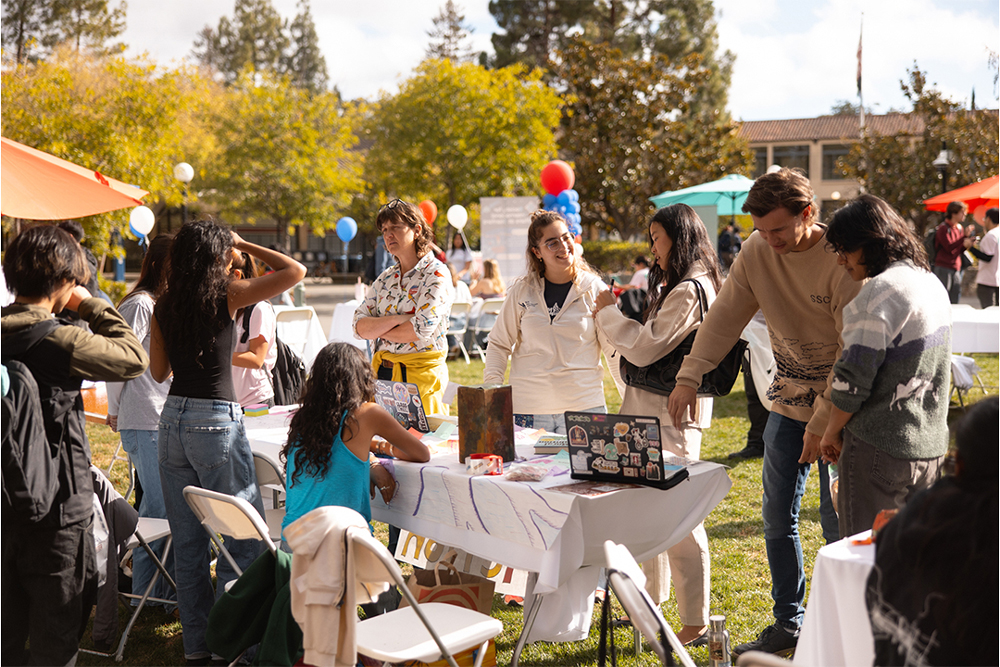 Photo: Andrew Brodhead/University Communications
On November 3, students celebrated Stanford’s sixth annual Democracy Day, a nonpartisan, universitywide academic holiday held on U.S. Election Day. Among the 20 events that day was student debate on hot political topics, a hackathon to build election prediction models, and an evening watch party.
CPR for a broken hierarchy.
Hierarchies aren’t inherently undesirable, according to Nir Halevy, a professor at the Graduate School of Business. But dysfunctional ones tend to be ultracompetitive, unjust, and unstable. In his new book, Level Up: Why Hierarchies Are Broken and How to Fix Them, Halevy offers three principles that can help: common value, pluralism, and relatedness (CPR). Common value refers to benefits that reach everyone in the hierarchy. Pluralism suggests hierarchies should offer multiple pathways to thrive and lead. And relatedness means the structure should bring people closer together. Though some solutions must come from the top (think evaluation systems and incentive structures), relatedness-enhancing behaviors like acknowledging others’ contributions can come from anyone. “Well-functioning hierarchies produce benefits for teams and organizations,” said Halevy. “Fixing a broken hierarchy is a great way to make a positive impact.”
But wait, there’s more…
This year’s El Niño promises to be among the most extreme on record. Stanford faculty with expertise ranging from environmental engineering to jumbo flying squid explain why—and what it means for people and ecosystems.
More than 50 years after Philip Zimbardo conducted the landmark Stanford Prison Experiment, Netflix was like: It’s the remix.
Stanford researchers have developed a noninvasive approach that combines ultrasound, light-emitting nanoparticles, and CRISPR to edit genes in the brain.
When Stanford senior and lifelong birder Marty Freeland snapped a picture of a yellow-browed warbler in Moss Beach, it was just the second time in history that the species—which breeds in Siberia and is supposed to head for Southeast Asia for the winter—was sighted in the contiguous United States.
Heigh-ho, heigh-ho, to outer space we go. Scientists have discovered a new dwarf planet candidate beyond the orbit of Pluto, affectionately dubbed 2026 ED138. If confirmed, it would be among the largest dwarf planets ever discovered in this region of the solar system.
The Wu Tsai Neurosciences Institute is launching the universitywide Stanford Digital Brain Project to train the most detailed and accurate models of human brain activity ever attempted.
“It’s just a lot of good decisions, a lot of good execution, a great coach,” said Valkyries owner Joe Lacob, MBA ’83, following his team’s WNBA championship win in just their second year of existence.
Note: The Loop sometimes links to articles outside of Stanford that may require a subscription to view.